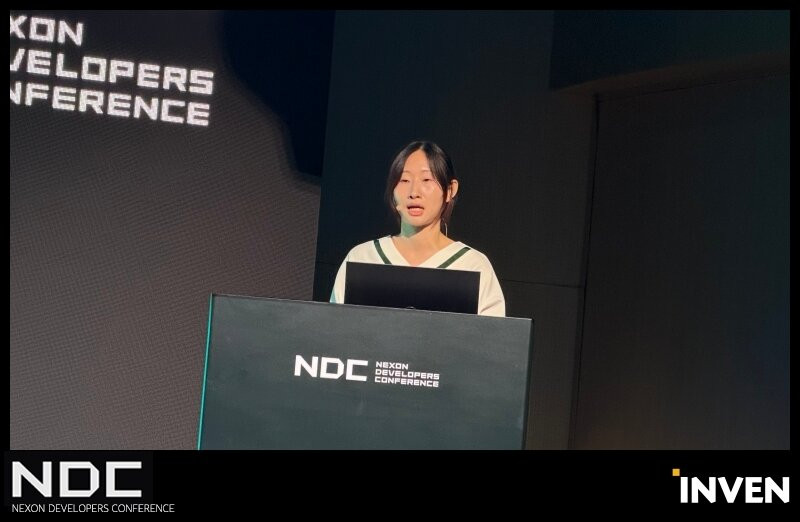
Topic: Do AIs Dream of Storytelling? – Using Generative AI in Game Narrative Design and Human Judgment of ‘Fun Speaker: Lee Ji-young – Nexon Korea Field: Artificial Intelligence / Game Design Recommended for: Narrative designers interested in building game scenarios, quests, and world-building Tags: #NDC26 #GenerativeAI #GameDesign
[🚨 Session Topic] This session shares practical experience in integrating generative AI into game narrative design, highlighting the potential and limitations of AI in storytelling and attempts to address them. A planner who prioritized writing good stories over mastering technology shares the trial-and-error process of using AI for world-building, scenario writing, and quest design, while discussing the importance of human roles and judgment in creative work and game enjoyment.
Game storytelling is often considered a uniquely human domain involving emotion and creativity. Can AI be used here? At NDC 26, Nexon Korea planner Lee Ji-young presented ‘Do AIs Dream of Storytelling?’, sharing her experience with generative AI in narrative design and concluding that “AI is merely a tool for executing human decisions quickly, not an entity that can judge what is fun.”
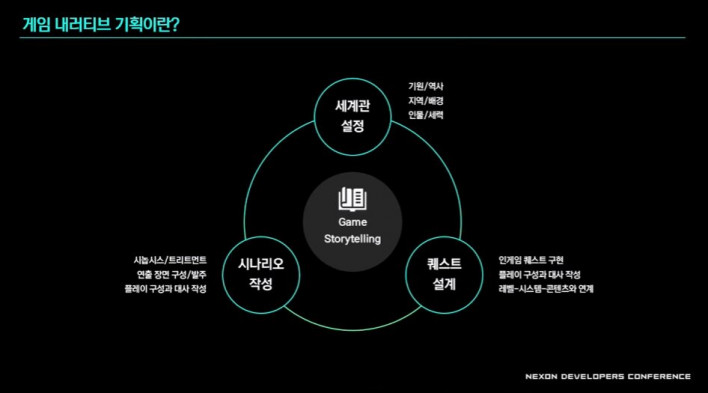
The speaker is a veteran game designer who has crafted scenarios and Quests for ‘Peria Chronicles,’ ‘Lost Ark,’ and Nexon’s ‘Project EL.’ Introducing himself as a “designer who wanted to write good stories more than innovate technology,” he stated that he would focus his presentation on practical examples from the perspective of a “general user utilizing AI,” rather than on technical analysis. The presentation covered the application of AI to the three pillars of game narrative design—world-building, scenario writing, and Quest design—as well as the “creative strategies for the AI era” he discovered along the way.
In the introduction, Lee quoted a passage from Philip K. Dick’s ‘Do Androids Dream of Electric Sheep?’, where the protagonist Rick Deckard, a hunter of androids, repeats to himself, “My career isn’t over yet,” despite his skepticism. She noted, “This felt similar to my anxiety when reading news about AI reducing jobs. I prepared this presentation while pondering what will remain for us who must live alongside AI, when even Deckard had his electric sheep as a symbol of empathy.”
World-Building – “Base Material Determines Plausibility”
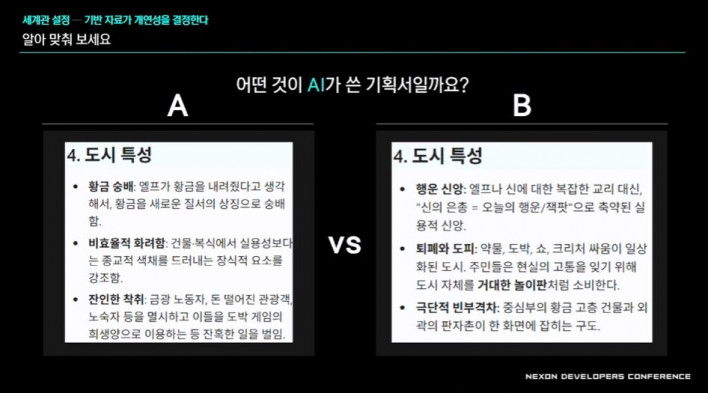
Lee began with a quiz, showing the audience two world-building documents, A and B, and asking them to guess which one was written by AI. The answer was B, but many in the audience chose A. She pointed out that “AI-written documents can sometimes be on par with human-written ones.”
As a practical example, she cited a regional setting document for a ‘Las Vegas-style gambling city’ in a fantasy world. After inputting a prompt of about 179 characters and waiting two minutes, a 12k-character draft was produced, 70% of which was usable. She explained, “While it looks like the result of a 100-character prompt in two minutes, it was backed by over 130k characters of base material, five hours of meetings, and 80 years of combined participant experience.”
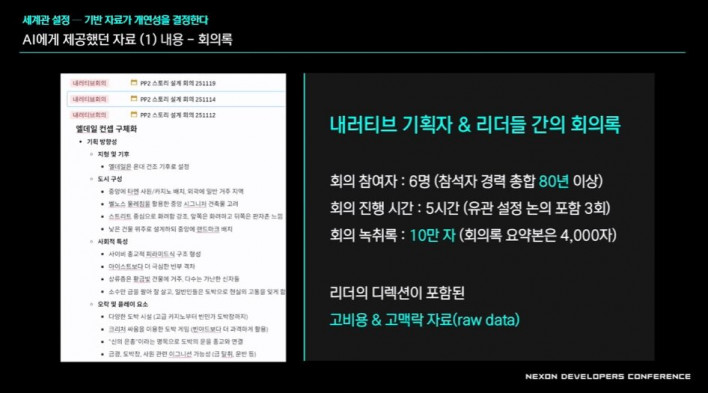
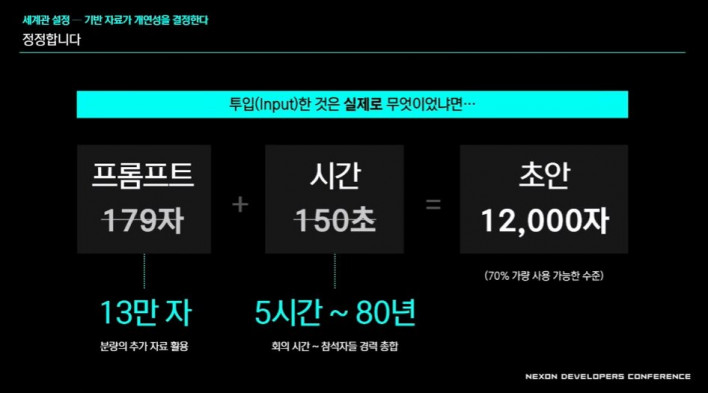
She particularly emphasized ‘meeting logs’. The core input consisted of logs from three meetings involving six people, including leads, which lasted over five hours, summarized by AI and then refined by humans. She described meeting logs as “high-context materials that condense the shared context of multiple planners.” By adding rejected human ideas (including plausible dialogue) and the format of other city setting documents, the AI was able to fluently fill in the gaps according to the structure.
Conversely, applying the same method to character settings yielded poor results. In the setting for a character named ‘Hide Jacques’, a spoiled nobleman, the signature dialogue was bizarre, and dialogue from a ‘Magic’ ‘Storage’ door in the scenario was incorrectly registered as the character’s signature line. She diagnosed the cause as a “difference in base material,” noting that while the prompts were nearly identical, she had only provided one document with little relevant content for the character setting.
She stated, “If working with a single source, I should have specified more concretely in the prompt which parts were important for characterization and how the story would unfold.”
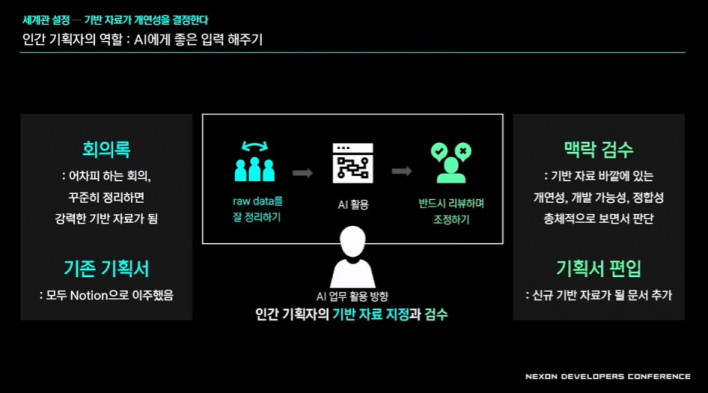
The conclusion for world-building was clear: even with the same prompt, good results require high-quality meeting logs and human-written documents. As a practical tip, she advised, “Organize the meetings you’re already having into high-context materials, and keep existing documents in formats AI can easily use, like Notion or Markdown files.” However, she emphasized, “Because AI is fluent but occasionally talks nonsense, humans must review and adjust for consistency and plausibility.”
Scenario Writing – “The Persistence of Averaging Even After Revisions”
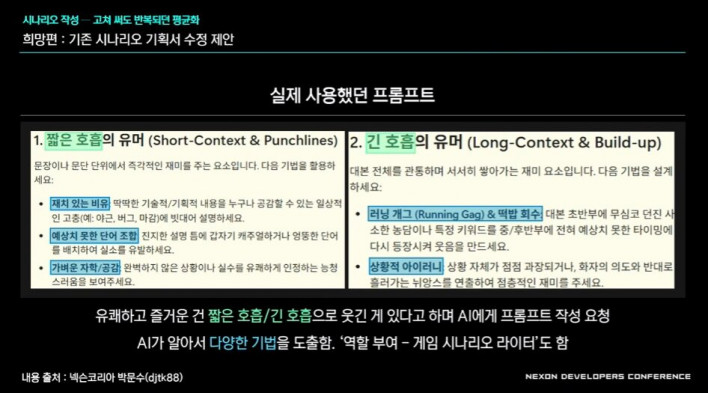
In the scenario section, she attempted to revise an existing human-written comedy script to be ‘funnier’ and to create new humorous episodes. The revision was relatively successful. Following advice from a colleague, she didn’t write the entire prompt herself but simply said, “Humor seems to have short and long rhythms, so please keep that in mind.” The AI produced a convincing revision using techniques like witty metaphors, unexpected word combinations, and light self-deprecation. She attributed this to “having provided plenty of human-written dialogue as a reference.”
However, creating new humorous episodes failed repeatedly. Even after inputting world-building, writing theory, and sample humor, the results were not funny. The sample humor she used was the ‘world’s funniest joke’ selected by British psychologist Richard Wiseman through his LaughLab experiment, involving a hunter asking a rescue worker to confirm his companion’s death, followed by a gunshot and the question, “Confirmed. What’s next.”
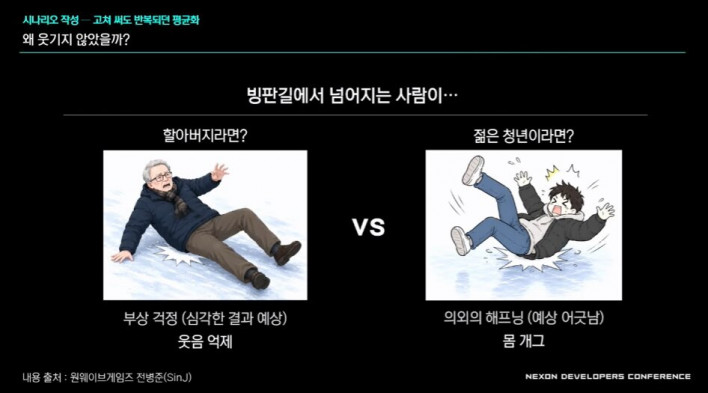
She found the reason for the failure in a colleague’s advice: AI follows the most plausible average from its training data, which weakens the element of surprise. She explained, “The core of humor—laughter—comes from deviating from expectations, or incongruity. Just as we suppress laughter when an elderly person falls on ice out of concern, but find it funny when a young person takes a dramatic tumble, surprise creates laughter.” Her diagnosis is that for an AI based on probability, such ‘design that defies prediction’ is difficult.
Her conclusion was: ‘Do not delegate judgment to AI.’ She argued, “You shouldn’t just say ‘make it funnier.’ Humans must judge and choose what is funny, then provide concrete scenes like ‘make him slip and perform physical comedy while walking.’ Only then can AI create the scene.” She suggested a division of labor: humans set the direction with the big picture of context and meaning, while AI performs the execution.
Quest Design – “AI for Data, Humans for Polishing”
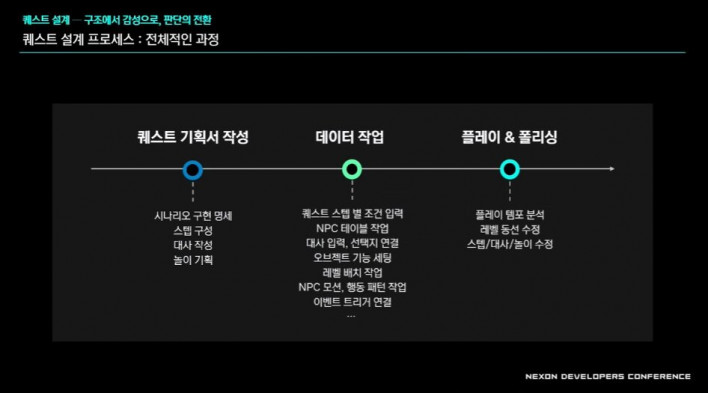
Based on this realization, she actively utilized AI’s ‘execution’ ability in quest design. She noted the importance of quest planning, as game storytelling is an ongoing process that interacts with users rather than a one-time creation. Quests go through document writing, → data work (implementing NPCs, objects, levels, motion, AI triggers, etc.), and → polishing (refining dialogue and composition through play). She proposed leaving the polishing—which requires judgment of fun and feel—to humans, while deploying AI for repetitive, labor-intensive data work.
The key was aligning the document structure with the data structure. She specified execution units in Notion, such as mapping ‘Heading 2’ to quest step data and specific formats to NPC dialogue data. She then fed the AI existing quest data systems and functions to teach it “what quest data looks like for this team.” Planners didn’t need to memorize complex conversion rules; they wrote documents in a ‘treatment’ format as usual, and the AI converted them into data-generation documents.
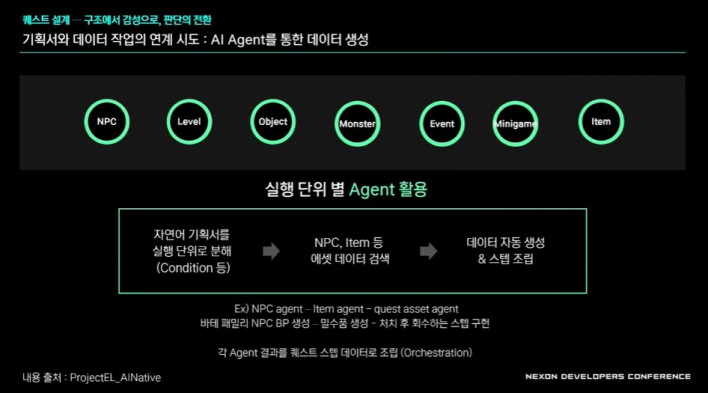
Data generation was performed using an ‘AI Agent’ approach. Specialized agents for each planning task—such as a NPC agent or a Item agent—were used to create data on behalf of the planner, which were then combined into a single quest data file. For example, for a step involving the ‘Elimination’ of a specific enemy group, the NPC agent would pull a model from existing ‘Unreal engine’ assets and assign ‘Monster’ attributes and ‘Skill’ sets, while the Item agent would attach items dropped upon ‘Elimination’.
She introduced pilot results implemented by her colleagues. By inputting only the document, data and sequences were automatically generated in the Unreal map. It reached a playable level where running to a NPC and talking would accept the quest, and defeating automatically placed enemies would fulfill the completion conditions. Construction took about two weeks.
She noted, “Time and costs for the data work stage were significantly reduced,” but drew a line, adding, “Fun-related judgments, such as monster placement intervals or dialogue length during play, still required human playtesting and polishing.” She cited the benefit: “Previously, we were buried in repetitive data work and lacked time to even refine dialogue, but now planners have time to think more deeply and consider the fun.”

However, the project to which this quest auto-generation pipeline was applied was later canceled. She mentioned during the presentation that the project was canceled while she was building a separate verification program for data correction and error handling, which aligns with the fact that Nexon Korea decided to cancel the development of ‘Project EL’, an ‘Open world’ new title dubbed ‘Fantasy GTA’, in April of this year.
Creative Strategy in the AI Era – The ‘Context’ Surrounding Text
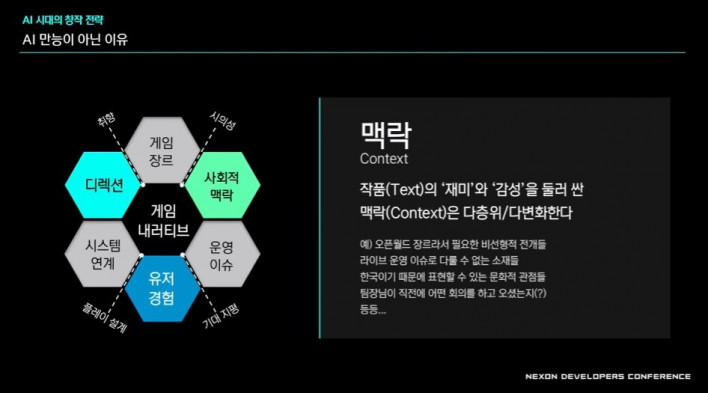
Concluding the presentation, she pointed out that while AI generates vast amounts of text, the context surrounding that text varies greatly. In an ‘Open world’ game, understanding non-linear storytelling is the context; in a live game, operational issues are the context. She said, “AI lacks the tokens to reflect all these real-world contexts at once, and even if you break it down through orchestration, AI won’t know things like ‘the team leader just finished a meeting with a bad expression, so we need to fix the quest that just went into the build’ unless you summarize and input every detail.” She reiterated, “AI is a tool for execution, not an entity that thinks and judges.”
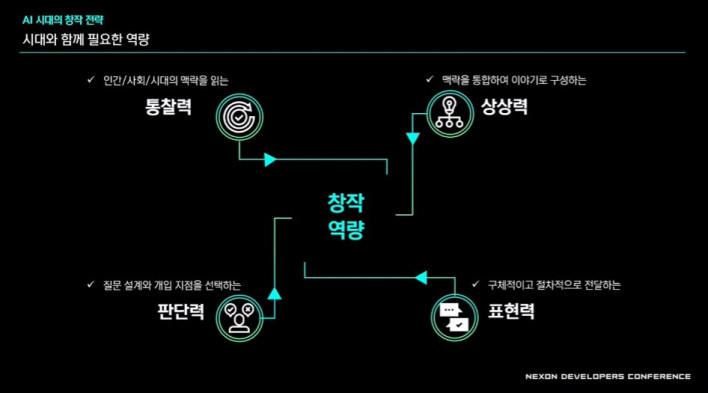
She also found the reason for the difficulty in judging ‘fun’ in context. What is considered fun changes depending on the culture, genre, and target user base. She identified the necessary skills in this era as: insight to read numerous contexts, imagination to weave fun into stories, judgment to select what to use and discard from AI-generated content, and expression to properly convey one’s thoughts to AI.
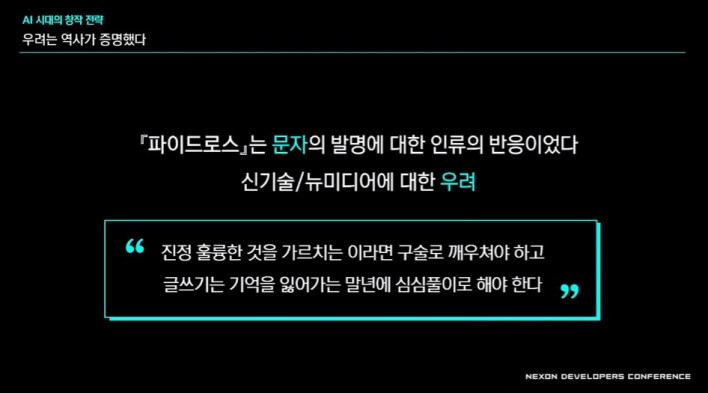
To concerns that ‘AI might harm human creativity,’ she responded by citing the critique of writing in Plato’s ‘Phaedrus’. A critique from the BC era warned that ‘writing would cause people to neglect memory exercises and implant forgetfulness in their souls,’ yet 2000 years later, we know the civilizational progress writing brought. She concluded, “Humanity’s abilities are not degenerating but changing. Just as the invention of writing changed human culture, so will the emergence of AI. Whatever tools we use, we will continue to dream, create, and enjoy storytelling that conveys the world, life, love, and emotion.”
Q&A – “Even Without a Base, Even in Small Teams”

The subsequent Q&A session focused on practical applicability. When a graduate student asked, “If it only works with lots of reference material, isn’t it difficult for small organizations or non-majors who struggle with data preparation?”, she cited cases of solo developers searching for classic works mentioned by AI or cross-verifying with different models, answering, “I believe it is possible to build things little by little while verifying, even if the narrative base is lacking.” She added, “Ultimately, humans will have to review the output in the tech field as well.”
Asked about learning methods for aspiring planners, she admitted she also struggled as a liberal arts major and recommended “continuously conversing and adjusting with AI, and utilizing indirect materials like ‘YouTube’.” She also expressed a wish: “Tech fields have well-accumulated and shared know-how; I hope there will be a community for planning where we can accumulate and share ‘how we tried to create narratives with AI and why we failed or succeeded’.”
Regarding the ‘criteria for judging fun,’ she introduced the “traditional method of playing many fun games and referring to community reactions and ratings,” along with pre-training AI with references suitable for the genre being created (e.g., examples of non-linear progression in ‘Open world’ games). She said, “If one day people say ‘what AI made is more fun,’ then perhaps AI can judge fun, but as long as the entity enjoying the game is human, humans understand humans best,” keeping the realm of judgment and choice with humans.
Notably, a programmer attendee commented, “If you hid the title, you wouldn’t be able to tell it wasn’t an ‘AI agent coding best practice’ case,” and was impressed by the creation of defined data and structures based on intent and context. He asked about the presence of a structure (harness) to verify errors when AI handles data tools, and how to manage changes when planning intent shifts.
Lee revealed that the project was canceled while she was building a separate verification program. Regarding change management, she replied, “I proceeded by breaking down meeting “Logs’ into specific units, designating the latest logs as the primary reference, and previous context as auxiliary material.” To a question about whether user data could be used for scenarios, she replied, “Since user reactions are the strongest basis for judging fun, I would refer to half of it, while having planners discuss and vary the other half to avoid repetitive patterns.
[Read Original]
PakarPBN
A Private Blog Network (PBN) is a collection of websites that are controlled by a single individual or organization and used primarily to build backlinks to a “money site” in order to influence its ranking in search engines such as Google. The core idea behind a PBN is based on the importance of backlinks in Google’s ranking algorithm. Since Google views backlinks as signals of authority and trust, some website owners attempt to artificially create these signals through a controlled network of sites.
In a typical PBN setup, the owner acquires expired or aged domains that already have existing authority, backlinks, and history. These domains are rebuilt with new content and hosted separately, often using different IP addresses, hosting providers, themes, and ownership details to make them appear unrelated. Within the content published on these sites, links are strategically placed that point to the main website the owner wants to rank higher. By doing this, the owner attempts to pass link equity (also known as “link juice”) from the PBN sites to the target website.
The purpose of a PBN is to give the impression that the target website is naturally earning links from multiple independent sources. If done effectively, this can temporarily improve keyword rankings, increase organic visibility, and drive more traffic from search results.