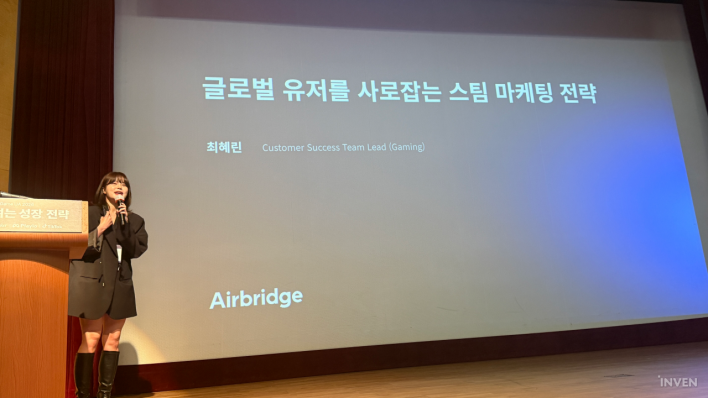
At the ‘Game UA 2026: Growth Strategy Seminar via AI’ held on June 4, Choi Hye-rin, Customer Success Team Lead at AB180 (hereinafter ‘Lead Choi’), gave a presentation on ‘Steam Marketing Strategies to Captivate Global Users.’ At AB180, Lead Choi supports the global growth strategies of domestic and international game companies through attribution and marketing solutions Airbridge and Airflux.
At the start of her presentation, Lead Choi noted, “I am not particularly adept at using AI myself, so I have boldly excluded AI-related content.” Instead, she focused on Steam marketing—a relatively unfamiliar territory for mobile marketers—noting the recent increase in job postings for ‘Steam Marketers’ in the gaming industry. She explained that this approach is intended to prepare for the eventuality of launching a company’s games on Steam.
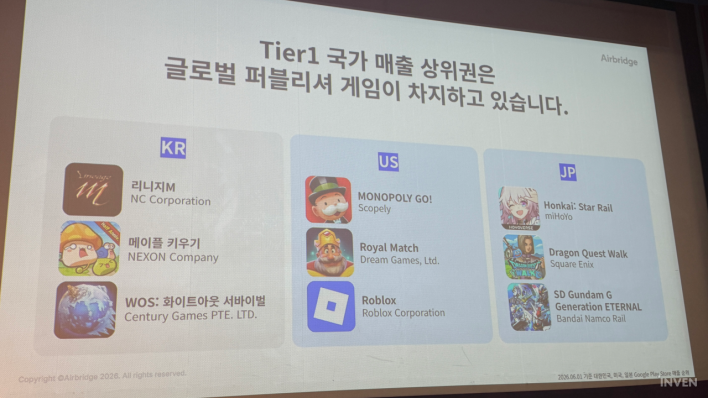
Lead Choi opened her main discussion by diagnosing that it has become difficult to find titles from Korean game companies in the global market. Presenting Google Play revenue rankings for Korea, the U.S., and Japan as of June 1, she explained that while domestic titles like ‘Lineage’ or ‘MapleStory Grow’ are visible in Korea, the share of global game companies increases as one looks toward the U.S. and Japan. She added that in major marketing target countries like the U.K., Taiwan, and Indonesia, games from global publishers also dominate the top ranks. She further noted that in download rankings for the U.S. and Japan, foreign titles such as ‘arrow puzzle’ games or ‘Royal Kingdom’ show strong performance.
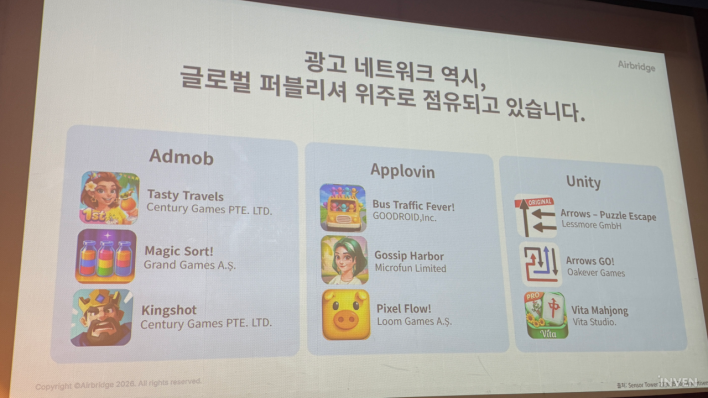
She identified ad network market share as a larger problem. According to Lead Choi, the May market share of major ad networks like AdMob, AppLovin, and Unity is dominated by global publishers from countries including China, Japan, Germany, and Turkey. She pointed out that large game companies like Century Games have already secured not only puzzle games but also various genres like merge games through their capital power, making direct competition difficult with standard budgets.
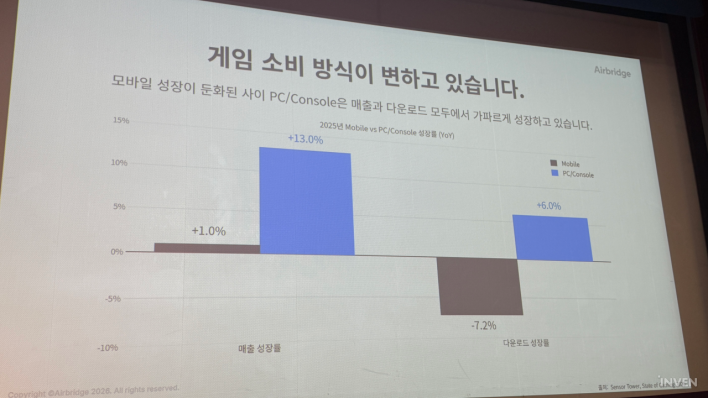
User consumption patterns for games are also changing. Lead Choi analyzed that as mobile game downloads turned to a decline in 2025 and revenue growth stalled at the 1% level, the structure has shifted from one driven by new user acquisition to one driven by retention and increased spending from existing users. She added that the consumption flow is moving from games where users consume fixed content to UGC game platforms (such as ‘MapleStory Worlds’) where users create content and interact directly.
While mobile growth has slowed, PC and console markets are growing rapidly in both revenue and downloads. Lead Choi assessed that with revenue growth rates of approximately 13% and download growth rates of about 6%, the PC and console market still has sufficient room for growth, unlike the mature mobile market.
Steam is the platform at the center of this shift. According to public data cited by Lead Choi, Steam’s Monthly Active Users (MAU) reached approximately 140 million in 2025, an increase of about 11% year-on-year. Concurrent Users (CCU) surpassed 40 million for the first time in 2025 and have recently exceeded 42 million, which is about double the level seen in 2020.
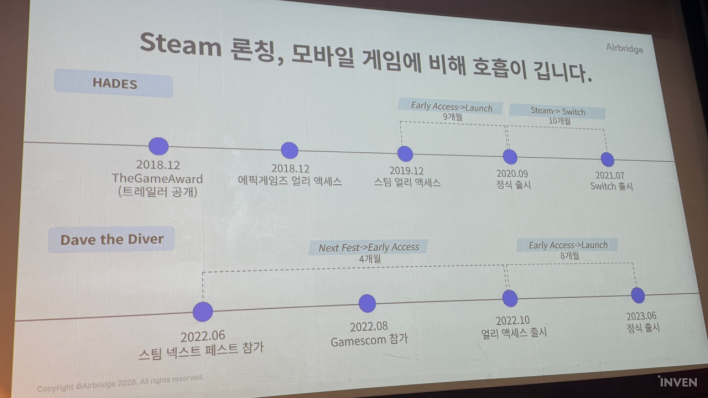
Lead Choi emphasized that while Steam marketing concepts like Wishlists, Early Access, and Steam Store Tags can be understood by comparing them to mobile’s pre-registration, launch, and App Store keywords, they are fundamentally different in nature.
First, the launch rhythm on Steam is longer than on mobile. She cited the roguelite game ‘Hades,’ which entered Epic Games Early Access after its trailer release in December 2018, moved to Steam Early Access about a year later, took another 9 months for its official release, and an additional 10 months for its Switch release. MINTROCKET’s ‘DAVE THE DIVER’ started with the Steam Next Fest in June 2022, took 4 months to reach Early Access, and another 8 months from Early Access to official release. NEOWIZ’s ‘SANABI’ took about two years and 8 months from its Steam demo release to its official launch.
Second, there is no set answer for Steam marketing. Steam states that there is no bias toward paid exposure within the disclosed scope, and store tags effectively influence all recommendation algorithms. Unlike mobile, there is no standardized methodology such as running CPI campaigns followed by retargeting campaigns.
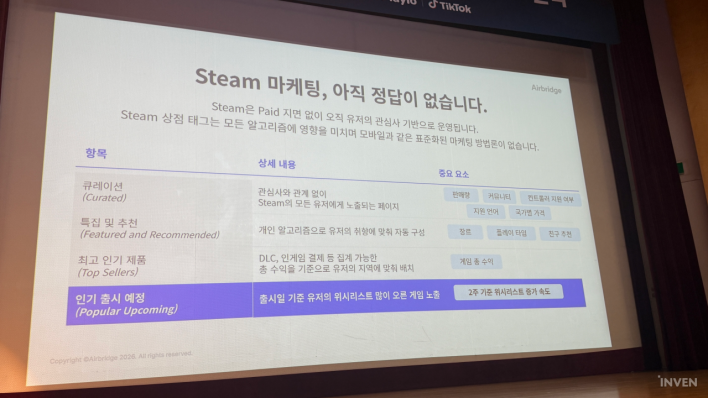
Lead Choi introduced four exposure areas that are particularly important on Steam. The curation page is a page where Steam directly selects games to expose to all users regardless of their interests; factors such as sales volume, community management, controller support, supported languages, and regional pricing are critical for entry.
The ‘Featured & Recommended’ tab is composed based on individual user algorithms, so preferred genres, playtime, and recommendations from Steam friends play a role. ‘Top Sellers’ is arranged according to the user’s region based on total revenue that can be aggregated, including DLC and in-game purchases. The ‘Popular Upcoming’ section, which is important for pre-launch exposure, considers not only the cumulative number of wishlists but also the rate of wishlist growth on a two-week basis.
Next, Lead Choi suggested that Steam marketing should be managed in an integrated manner across four pillars: Wishlists, Steam official programs, community, and influencers.
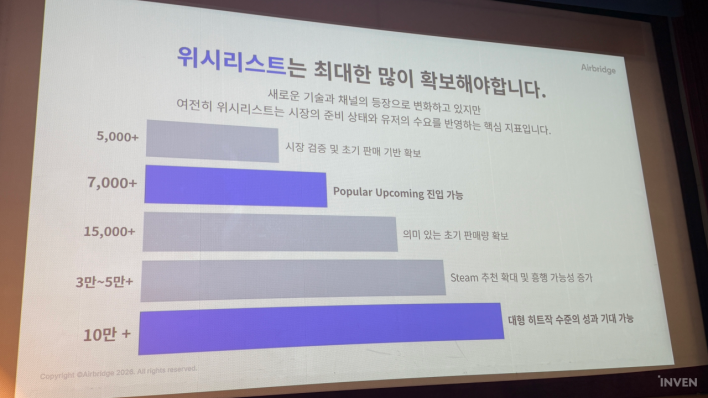
① Wishlist – Despite the emergence of new technologies and channels, the wishlist remains a key indicator for predicting market readiness and user demand. While Steam does not provide official conversion figures, many developers and publishers have empirical benchmarks for different segments. Exceeding a certain level leads to market validation, securing an initial sales base, entry into the ‘Popular Upcoming’ tab, meaningful initial sales volume, and an increased probability of Steam recommendations; reaching higher tiers can lead to results on par with major hits.
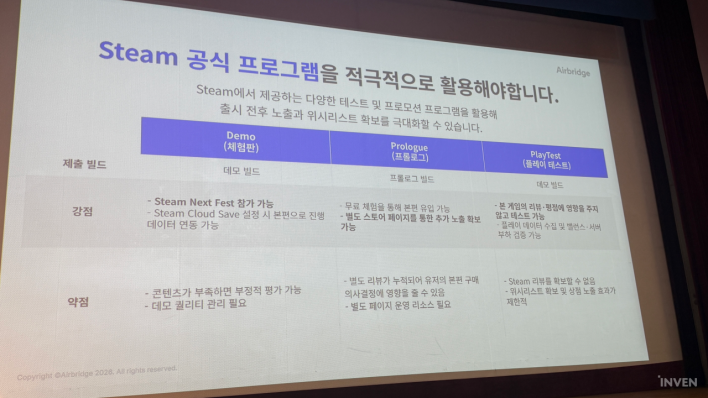
② Steam Official Programs – One must actively utilize the testing and promotional features provided by Steam. Testing features include: ▲ ‘Demo’ for Next Fest participation (demo play data can be linked to the full version if cloud saves are set, though there is a risk of negative reviews if content is lacking); ▲ ‘Prologue,’ which operates on a separate page from the main store (can secure additional exposure, but negative reviews can adversely affect purchase decisions for the main game, and it requires separate operational resources); and ▲ ‘Playtest,’ which verifies play data, balance, and servers without affecting the main game’s rating.
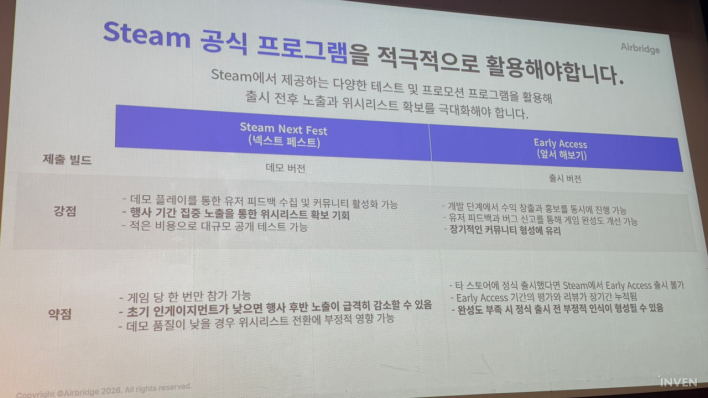
Promotions are represented by Next Fest and Early Access. Next Fest is an event conducted with demo builds, a festival held by Steam three times a year for one week to gather upcoming releases in one place. It allows for concentrated wishlist acquisition and large-scale open testing at a low cost, but each game can participate only once, and low initial engagement (especially in the first 48 hours of exposure) can lead to reduced exposure later in the event. Low demo quality also negatively impacts wishlist conversion. Early Access is a version that allows for revenue generation and promotion during the development phase, which is advantageous for long-term community building as the community forms early. However, if a game has already been officially released on other stores like Epic Games, it cannot be released as Early Access on Steam and must be released as a full version.
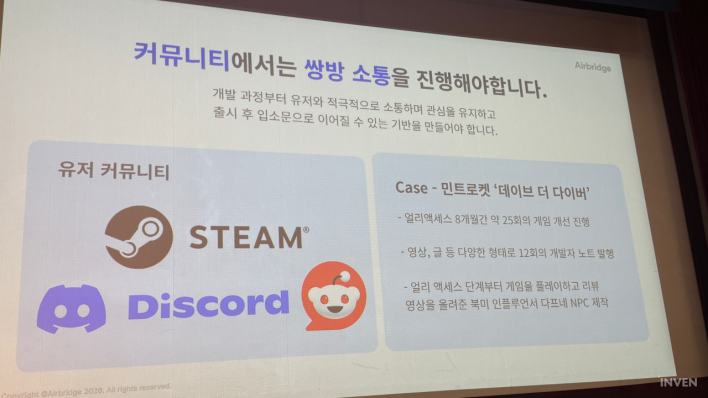
③ Community – This is the pillar Lead Choi emphasized as particularly important. Through two-way communication between the game company and users, interest must be maintained from the development process, creating a foundation that leads to word-of-mouth after launch. She cited ‘DAVE THE DIVER’ as a best practice. During its 8 months of Early Access, the team implemented about 25 game improvements, published developer notes in various forms such as videos and articles, broadcasted YouTube shows in Korean and English with every update, and communicated with users daily via Discord. They also received a positive response by creating an in-game NPC based on a North American influencer who played the game from the Early Access stage.
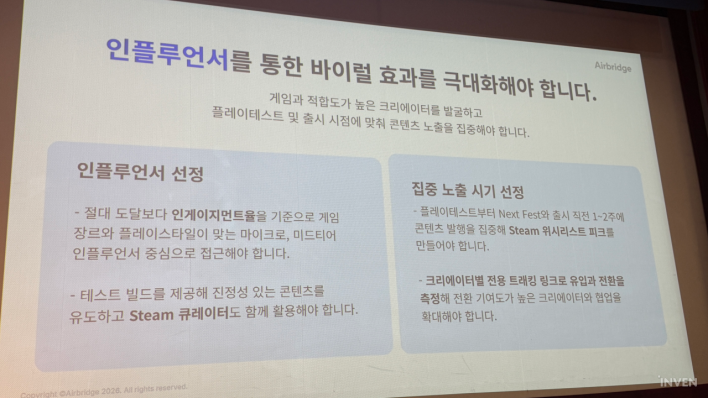
④ Influencer – This is the pillar that maximizes viral effects. While a higher number of followers is advantageous, it is more effective to recruit many micro-to-mid-tier influencers who fit the game’s genre and playstyle based on engagement rates rather than absolute scale. One should also utilize methods such as providing test builds to maintain authentic content. Steam Curators are like influencers active within Steam; one can send keys or request messages directly through Steam, and they are worth utilizing actively due to high user trust.
Lead Choi also emphasized timing. One must concentrate content publication from Playtest to Next Fest and the 1-2 weeks just before launch to create a period where wishlists peak. This is because the volume, rate, and speed of wishlist growth significantly influence other indicators. If dedicated tracking links for each creative can be secured, one can measure inflow and conversion per link to expand collaboration with creators who have high conversion contributions.
[Read Original]
PakarPBN
A Private Blog Network (PBN) is a collection of websites that are controlled by a single individual or organization and used primarily to build backlinks to a “money site” in order to influence its ranking in search engines such as Google. The core idea behind a PBN is based on the importance of backlinks in Google’s ranking algorithm. Since Google views backlinks as signals of authority and trust, some website owners attempt to artificially create these signals through a controlled network of sites.
In a typical PBN setup, the owner acquires expired or aged domains that already have existing authority, backlinks, and history. These domains are rebuilt with new content and hosted separately, often using different IP addresses, hosting providers, themes, and ownership details to make them appear unrelated. Within the content published on these sites, links are strategically placed that point to the main website the owner wants to rank higher. By doing this, the owner attempts to pass link equity (also known as “link juice”) from the PBN sites to the target website.
The purpose of a PBN is to give the impression that the target website is naturally earning links from multiple independent sources. If done effectively, this can temporarily improve keyword rankings, increase organic visibility, and drive more traffic from search results.