
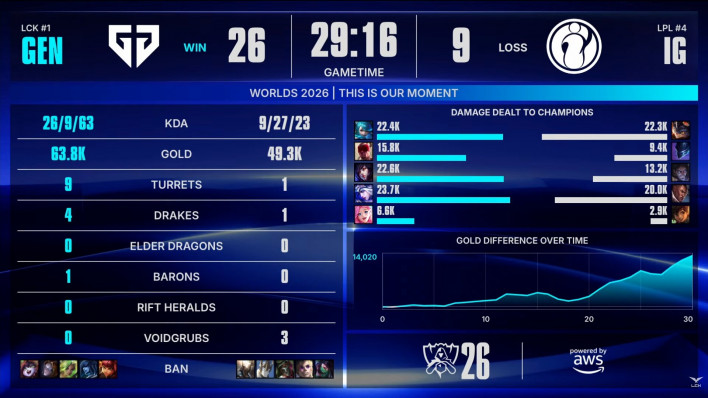
Gen.G also took Game 2, leaving them just one win away from the finals.
Gen.G’s momentum continued into Game 2. While ‘JiaQi’ on Lucian and ‘Meiko’ on Milio secured lane priority through favorable trade exchanges, their tower dive backfired when they failed to finish off ‘Ruler’ Park Jae-hyuk’s Ashe, giving up two deaths instead. Simultaneously, ‘Canyon’ Kim Geon-bu’s Lee Sin teamed up with ‘Kiin’ Kim Ki-in’s Gwen to cleanly take down ‘TheShy’ Kang Seung-lok’s Rumble.
To make matters worse for IG, a top-lane three-man dive targeting Gwen resulted in ‘Rookie’ Song Eui-jin’s Sylas being traded. Meanwhile, ‘Chovy’ Jeong Ji-hoon’s Ahri was pulling ahead in CS in the mid lane. A bottom-lane gank using ‘Wei’s’ Nocturne ultimate was also completely read by Gen.G, giving up a double kill.
Although Gen.G lost their bot duo during a mid skirmish to plays from Rumble and Sylas, they minimized their losses by taking the dragon. In the following standoff, Ahri’s initiation picked off Milio, allowing Gen.G to push down the mid outer tower. They then accurately caught Lucian after he dashed forward with E in the mid lane, sweeping up three kills and securing Baron as their reward.
Around the 22-minute mark, during Gen.G’s third dragon timing, ‘Duro’ Joo Min-kyu’s Seraphine was caught out. Despite this, Gen.G’s main force, having already taken position, forced the dragon, and in the ensuing fight, Gwen and Lee Sin survived to the end to score an Ace. The global gold difference expanded to 10,000. Although Gwen was caught once, it had no effect on the overall outcome. Winning the final dragon soul teamfight decisively without upset, Gen.G sealed the game.
[Read Original]
PakarPBN
A Private Blog Network (PBN) is a collection of websites that are controlled by a single individual or organization and used primarily to build backlinks to a “money site” in order to influence its ranking in search engines such as Google. The core idea behind a PBN is based on the importance of backlinks in Google’s ranking algorithm. Since Google views backlinks as signals of authority and trust, some website owners attempt to artificially create these signals through a controlled network of sites.
In a typical PBN setup, the owner acquires expired or aged domains that already have existing authority, backlinks, and history. These domains are rebuilt with new content and hosted separately, often using different IP addresses, hosting providers, themes, and ownership details to make them appear unrelated. Within the content published on these sites, links are strategically placed that point to the main website the owner wants to rank higher. By doing this, the owner attempts to pass link equity (also known as “link juice”) from the PBN sites to the target website.
The purpose of a PBN is to give the impression that the target website is naturally earning links from multiple independent sources. If done effectively, this can temporarily improve keyword rankings, increase organic visibility, and drive more traffic from search results.