
The Korea Game Law and Policy Society (President Yoo Byung-joon) held its spring academic conference on the 15th at Seoul National University’s Supex Hall under the theme, ‘Development Strategy for the Game Industry as a National Strategic Industry.’ The conference was hosted by the society, organized by the Seoul National University College of Business, and sponsored by the Korea Association of Game Industry.
The society assessed that the game industry has recently emerged as a core national strategic industry in both cultural and economic terms. Consequently, it provided a forum to discuss integrating blockchain and fintech into the gaming ecosystem and revitalizing venture investment in the sector through the Fund of Funds.
In the first session, Professor Jeon Sung-min (Gachon University) presented on ‘Strategizing the Game Industry as a K-Content Industry,’ outlining directions for the industry’s strategic development as a core pillar of Hallyu content and ways to strengthen national competitiveness. In the second session, Professor Kang Hyung-gu (Hanyang University) spoke on ‘The Introduction of Stablecoins in Game Economic Systems and Their Economic Effects,’ focusing on the impact of blockchain-based financial technology on in-game economic ecosystems and its regulatory implications. In the third session, Professor Choi Young-geun (Sangmyung University) discussed ‘Operation of the Fund of Funds Game Fund and Revitalization of Venture Capital Investment in Games,’ presenting on the structure and improvement directions for how public funds and private capital contribute to the growth of the game industry.
Following the presentation sessions, a panel discussion and Q&A were held, moderated by Hwang Sung-ki, Chairman of the Game Self-governance Organization of Korea. Panelists included Kwon Gu-min, Senior Researcher at the Korea Creative Content Agency (Content Industry Policy Research Center), Professor Shin Eun-jung (Baekseok University), Choi Seung-hoon, Director at the Korea Association of Game Industry, and Professor Shin Hye-ryun (Myongji University).

President Yoo Byung-joon (Professor at Seoul National University College of Business) noted, “Amid the rapid development of AI technology and changes in the platform environment, the game industry has evolved faster than ever and established itself as the core of the cultural content industry. These rapid changes open new opportunities for us while simultaneously presenting complex legal and policy challenges that are difficult to address within existing frameworks.”
“Games are a Strategic Industry in the AI Era”

Professor Jeon Sung-min stated, “If semiconductors are the ‘rice’ of the Korean economy’s hardware, games are the operating system (OS) of the AI era and a core software strategic asset that expands our digital territory. Therefore, it is necessary to move the game industry beyond general support and designate it as a national strategic technology and a national high-tech strategic industry, concentrating pan-national capabilities on it.”
According to the presentation, from a business management perspective, the game industry records a high value-added inducement coefficient (0.493) and employment inducement coefficient (10.44), acting as a low-cost, high-efficiency driver of the national economy. For comparison, the value-added inducement coefficient for semiconductors is around 0.3–0.4. Professor Jeon emphasized, “When compared to existing national high-tech strategic industries like semiconductors, bio, and secondary batteries, the economic ripple effect and technical value of the game industry are immense.”
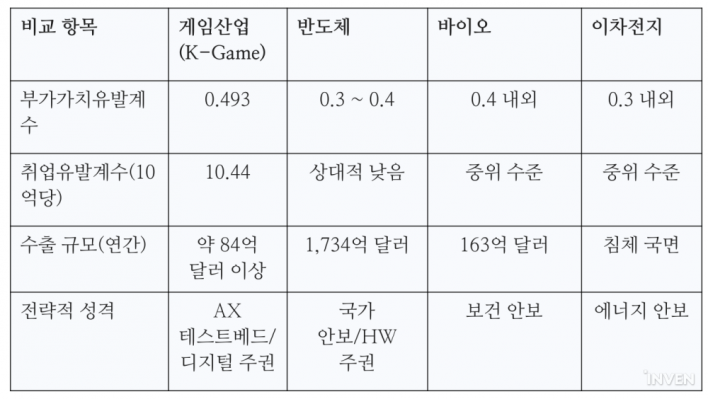
He pointed to policy discrimination in the tax system as one of the biggest barriers facing our game industry. To receive current tax credits for technology development, companies must secure an independent research space with a separate entrance, which directly conflicts with the game development process where planners, programmers, and artists must collaborate organically. Furthermore, the National Tax Service requires scientific advancement compared to existing technology, but because the criteria for whether live updates or porting work constitute technical progress are ambiguous, they are frequently excluded from tax deductions.
Professor Jeon emphasized, “We must designate game engines, real-time rendering, and game-specific AI technology as national strategic technologies and provide tax credits on par with the semiconductor industry. This will serve as the cornerstone for forming security assets to reduce reliance on foreign engines, achieve technological independence, and secure digital sovereignty.” Semiconductor-level tax credits reach up to 50% for technology development and up to 35% for facility investment.
However, designating them as national strategic technologies based on existing manufacturing standards could actually hinder the development of the game industry. Therefore, Professor Jeon proposed the enactment of a tentative ‘Special Act on Content National Strategic Industries.’ This special act includes provisions to shift to an IP-centered support system and legalize the transfer of tax credit rights to third parties or extend the carry-forward deduction period so that small, loss-making developers can enjoy tax benefits. He also called for the creation of game-specialized clusters similar to semiconductor clusters, providing intensive support such as special treatment for resident companies, priority supply of power and dedicated networks, and the provision of testbeds.
Professor Jeon defined the industry, stating, “From a management perspective, the current global industrial reorganization is transforming into a structure where only countries and companies that control platforms, data, and AI algorithms can survive. In this view, games are not mere entertainment, but core technical assets leading the AX (AI Transformation) era and a bastion of digital sovereignty directly linked to national security.” He warned, “If we miss this golden time, we will have no choice but to yield technological hegemony to Saudi Arabia, which is already pouring tens of trillions of won into the sector, or to China, which is expanding its global territory based on the strength of its domestic market.”
Innovation in Game Payments, Settlement, and Community through Token Economy

Professor Kang Hyung-gu diagnosed, “The core of the current digital asset discussion is not about issuing new tokens, but about financial business innovation that redesigns payments, distribution, fundraising, and customer bases.”
The analysis suggests that stablecoins could be a solution for game companies suffering from platform fees and settlement delays. Professor Kang explained, “The core of stablecoins lies not in the coin itself, but in creating new customer and fee models by reducing cross-border payment and cash management time.” This means that for global esports prize payouts or overseas publishing settlements, payment speeds can be increased without being constrained by bank operating hours.
He also defined the role of the token economy as an ecosystem maintenance mechanism. “The realistic value of a token economy is not speculative incentive, but a “lock-in” mechanism that keeps payment, deposit, and investment customers in one ecosystem for a long time,” he noted. Memberships that link in-game assets with external benefits boost customer retention and expand cross-selling opportunities.
Ways to increase capital efficiency from an institutional investor perspective were also addressed. Professor Kang analyzed, “The core of tokenized collateral is not changing the nature of the asset, but reducing the time that safe assets move within the balance sheet and transaction flow.” The utility of collateral tokenization is demonstrated in segments where speed and control quality are directly linked to costs, such as over-the-counter (OTC) trading, repos (RP), and margin management.
Along with this, he presented specific adoption positions for game companies and emphasized operational efficiency. Professor Kang explained, “The immediate task for domestic game companies is not whether to sell new tokens, but where to create repetitive usage and operational efficiency among payments, settlements, communities, and creator rewards.” He also cited on-chain settlement as a means to make revenue sharing transparent in user-generated content ecosystems.
He identified ‘control quality’ as a success factor for digital asset-linked businesses. Professor Kang explained, “A game company’s digital asset strategy is determined not by a narrative of price appreciation, but by control quality that allows for the repetitive operation of accounts, payments, settlements, and customer protection without harming the game economy.” This means that mechanisms to control bots or market manipulation and to subdivide partner responsibilities are required.
Finally, he pointed out the need to set practical performance indicators that reflect the characteristics of the game industry. Professor Kang emphasized, “The winning move for domestic game companies is not competition in token issuance, but making global settlements and community operations faster and more transparent while protecting game quality and user trust.” Through this, game companies can shorten reconciliation times in refund or settlement processes and lower fraudulent transaction rates.
“Prevent the Initial Investment Gap”… Restoring the Dedicated Track for the Fund of Funds

Professor Choi Young-geun pointed out the structural capital drought facing the game industry from a venture investment perspective. Professor Choi diagnosed, “The absence of domestic game venture investment is not merely a result of the economic downturn, but a structural problem stemming from a long-term lack of risk capital based on an understanding of the game industry.”
He criticized the reality that capital is flowing into other industries despite the fact that securing initial funding is essential due to the nature of the game industry. Professor Choi analyzed, “As capital concentration in AI, bio, and ICT services has intensified, games have been pushed down in investment priority.” He added that funds in the domestic venture investment ecosystem are concentrated on late-stage companies, severing the supply chain of funds to early-stage startups.
He identified the government’s unclear policy signals as a major cause. Professor Choi noted, “Recently, the cultural account has not been functioning clearly as a game-dedicated account, failing to properly convey the government’s long-term investment will for the game industry to the market.” This contrasts with the structure in the U.S. or Europe, where public venture capital induces investment from private risk capital.
To restore the investment ecosystem, he proposed making the game-dedicated track within the Fund of Funds permanent. Professor Choi urged, “The game-dedicated track within the cultural account must be made permanent for industry-specialized fundraising. We must move away from the existing integrated track and design the game investment track to be divided into prototype, seed, Series A, and growth capital to enable professional investment tailored to the growth stage.”

He also demanded a clear expansion of fund size and an expression of policy will. Professor Choi emphasized, “We must restore a clear policy will for cultivation, like the independent game fund of 2014, to unify and scale up the game track.” The intent is to send a clear signal to the market to provide a justification for private capital to enter.
The introduction of unconventional safety nets to attract private capital was also discussed. Professor Choi said, “Considering the characteristics of game startups with high failure rates, I propose introducing a strengthened priority loss-cushioning structure at the prototype stage.” He added that a profit-sharing system should be designed and game-specialized reviewers should be cultivated to boost investment capabilities.
Professor Choi concluded his presentation by emphasizing the importance of a multi-layered fundraising ecosystem to overcome the limitations of the exit market that relies on initial public offerings (IPOs). He added, “We must design not only initial funding but also a multi-layered fundraising chain to support game startups’ preparation for global publishing, and expand channels to revitalize M&A and secondary sales tailored to the game industry.”
Panel Discussion

Kwon Gu-min, Senior Researcher at the Korea Creative Content Agency, evaluated the game industry as a digital convergence industry that combines AI, cloud, real-time rendering, and digital assets. Senior Researcher Kwon diagnosed, “The game industry is no longer just an industry that makes games, but is changing to play the role of technical infrastructure for the entire future digital industry.” He cited the case of NVIDIA, which grew from a graphics card company for games into a core AI company, to highlight the importance of technology transfer.
He pointed out the limitation that the current national strategic industry system, which is tailored to manufacturing, does not fit the project-based content industry. Senior Researcher Kwon explained, “The current national strategic industry system is designed based on a manufacturing-centered structure like semiconductors, displays, and secondary batteries. In contrast, games are a project-based industry where R&D, production, operation, updates, and global marketing are combined simultaneously.”
As a solution, he proposed building a new policy framework centered on intellectual property (IP) and creative talent. Senior Researcher Kwon urged, “We also need to review a policy framework such as a tentative “Special Act on Cultural Content Strategic Industries’ that includes strategic content designation, production cost tax credits, global publishing support, and strategic content funds.” The intent is to redefine games from the perspective of a comprehensive digital strategic industry that connects platforms and data.
Securing Payment Infrastructure Sovereignty and Tokenizing Future Revenue
Professor Shin Eun-jung of Baekseok University criticized the fee structure of global platforms and identified securing ‘payment sovereignty’ as a core strategy. Professor Shin pointed out the structural barriers of payment infrastructure, stating, “The reality is that 30% of game revenue goes to app markets like Google and Apple, and overseas settlement takes 30 to 90 days.”
She evaluated the stablecoin settlement system as a realistic means to break away from platform dependency. Professor Shin analyzed, “If a stablecoin settlement rail is applied, settlement time is reduced to a few minutes or hours, and fees are lowered to the 1–3% level.” She cited global cases such as Xsolla launching its own blockchain to operate virtual asset payments and Stripe commercializing stablecoin settlements as evidence.
In addition, she suggested diversifying the venture investment exit market through the issuance of profit-sharing securities as an alternative. Professor Shin suggested, “A method of tokenizing predictable revenue streams could be a new path for venture capital to secure liquid exits even at the pre-IPO stage.” This is the view that digital assets will be a tool to bypass market distrust of volatile coins and lead a virtuous cycle of capital.
AI-Based Process Changes and the Advent of the Platform Economy
Professor Shin Hye-ryun of Myongji University diagnosed that AI is going beyond game production processes to reshape the business model itself. Professor Shin analyzed, “With the spread of AI-based production tools, game development time is decreasing, and it has become possible for small teams to launch quickly and continuously improve by looking at data.”
She paid particular attention to the growth of user-generated content platforms and the synergy created by the combination with generative AI. Citing the cases of ‘Roblox’ and ‘MapleStory Worlds’, Professor Shin explained, “Future game business models are changing from simple game sales to a structure where users and creators continuously engage in economic activities within the platform.” The logic is that as the barrier to content production is lowered by the introduction of AI, the expansion of the platform ecosystem accelerates.
Professor Shin also urged the need for new policy responses to the explosion of content production. She pointed out, “There are piles of issues such as copyright problems for AI training data, liability for generative content, revenue distribution between platforms and creators, and rating classification and post-monitoring for exploding content.” Accordingly, she added that we must move away from the existing human-centered management method and equip ourselves with an AI-based game monitoring system.

Industrial Regulatory Environment and Investment Protection Devices
Choi Seung-hoon, Policy Director at the Korea Association of Game Industry, expressed concern that the manufacturing-centered national strategic technology designation method could conflict with content production sites. Director Choi pointed out, “An institutional design that separates pure R&D sectors strictly from the production process and targets them for national strategic industry designation is not suitable for the production sites of the content industry, including games.” He called for a shift in perspective to broaden the scope of protection to intellectual property itself rather than technology units.
He also warned of regulatory risks when applying digital assets to business models. Director Choi analyzed, “If wallet-linked rewards or partner points proposed as lock-in devices can be exchanged for cash value through on/off-ramps or external exchanges, there is a high risk that they will be interpreted as illegal currency exchange, which is strictly prohibited under current law.” He added that requiring game companies to have anti-money laundering infrastructure at the level of financial institutions is an excessive compliance burden.
However, he expressed support for the introduction of government institutional support devices to revitalize investment. Director Choi evaluated, “The policy design to more strongly introduce the government’s priority loss-cushioning device for prototype-stage funds will be a certain and powerful device to attract private investors.” He added that an inter-ministerial working group should be formed immediately to quickly deliver a cultivation signal to the venture investment market.
[Read Original]
PakarPBN
A Private Blog Network (PBN) is a collection of websites that are controlled by a single individual or organization and used primarily to build backlinks to a “money site” in order to influence its ranking in search engines such as Google. The core idea behind a PBN is based on the importance of backlinks in Google’s ranking algorithm. Since Google views backlinks as signals of authority and trust, some website owners attempt to artificially create these signals through a controlled network of sites.
In a typical PBN setup, the owner acquires expired or aged domains that already have existing authority, backlinks, and history. These domains are rebuilt with new content and hosted separately, often using different IP addresses, hosting providers, themes, and ownership details to make them appear unrelated. Within the content published on these sites, links are strategically placed that point to the main website the owner wants to rank higher. By doing this, the owner attempts to pass link equity (also known as “link juice”) from the PBN sites to the target website.
The purpose of a PBN is to give the impression that the target website is naturally earning links from multiple independent sources. If done effectively, this can temporarily improve keyword rankings, increase organic visibility, and drive more traffic from search results.